


To outsource WordPress development the right way, define the exact scope first, pick the right model (freelancer, offshore team, or white label partner), vet for code quality and communication with a small paid test, then protect your margin and your client relationship with a clear agreement.
The wrong partner costs you time, quality, and trust; the right one works like part of your team. We work as the outsourced team behind other agencies every day, so we see this from the inside. The agencies that win at outsourcing all do a few specific things before they hand over a single task, and the ones that get burned skip those steps.
This guide walks through the whole process the way an agency owner should actually run it: what to delegate, whether to outsource at all or hire someone, which model to use, what it costs, how to vet a partner, and how to keep the client relationship firmly in your hands.
What this guide coversWhat does it mean to outsource WordPress development?
Outsourcing WordPress development means hiring an external developer or team to build, fix, or maintain WordPress sites for your agency, instead of doing the work in-house. You keep the client relationship, the sales, and the strategy. The outsourced team handles the technical execution, often under your brand.
For agencies, this is usually about handling overflow work without expanding full-time staff. WordPress powers roughly 42% of all websites as of 2026, so client demand is constant, and hiring a full-time senior developer is a large fixed cost whether or not projects come in that month. ZipRecruiter puts the average US WordPress developer salary at $84,542 before benefits and overhead (as of August 2026). Outsourcing turns that fixed cost into a flexible one that rises only when revenue does.
What WordPress work can you actually outsource?
You can outsource almost any WordPress task, but each one needs a different depth of skill. Treating WordPress as a single skill is the first mistake agencies make. A developer who is fast inside a page builder is not always strong at custom PHP.
Common tasks agencies outsource:
Full custom website builds
Theme customization and child theme development
Custom plugin development and modification
WooCommerce and eCommerce store builds
Website migrations and host transfers
Page speed and Core Web Vitals optimization
Security hardening and malware cleanup
REST API and third-party integrations (CRM, payment, marketing tools)
The practical takeaway: match the task to a partner who does that specific work daily. Ask for portfolio examples of the exact task you need, not just "WordPress work" in general. Four categories come up most often, and each one behaves differently when you outsource it.
Outsourcing custom WordPress development
Custom work means anything the theme and plugin ecosystem does not already do: bespoke post types, custom fields architecture, tailored admin workflows, or integrations with a client's internal systems. Partner selection matters most here, because whoever comes next has to maintain the output.
Ask two questions before you hand this over. Who owns the code and the repository, and where is it documented? Undocumented custom work becomes the most expensive thing on a site. Every future change starts with someone reverse-engineering the last developer's thinking. Price this by complexity rather than page count. A ten-page site with three custom integrations costs more than a forty-page brochure site.
Outsourcing WordPress plugin development
Plugin work splits into two very different jobs. Modifying an existing plugin's behaviour is usually contained and quick. Building a plugin from scratch is a software project with a maintenance tail.
The maintenance tail is what agencies underestimate. A custom plugin needs updating as WordPress core changes, as PHP versions move, and as requirements shift. Agree upfront who handles that and at what rate. Insist on standards-compliant code and proper hooks rather than core file edits. Our guide to fixing a plugin that is not working covers what badly built plugins do to a site later.
Outsourcing WordPress design
Design and development are separate skills, and one partner is rarely equally strong at both. Some agencies outsource design and keep the build in-house. More often they do the reverse, since design carries the client's brand and sits closer to the relationship.
If you outsource design work, agree the deliverable format in writing. A Figma file with defined components is buildable. A flattened image is not, and that gap turns into billable hours somewhere. If you outsource the build from your own designs, the same rule applies in reverse: specify breakpoints, states and interactions, or the developer will make those decisions for you.
Outsourcing WordPress support and maintenance work
When agencies outsource WordPress support, they often treat it as a smaller version of development. It is not. Support runs continuously rather than as a project: updates, backups, uptime monitoring, security patches and small fixes.
That difference matters commercially. Maintenance is the most predictable recurring revenue an agency can sell. Post-launch costs typically run 15% to 25% of the original build cost per year, and that money goes somewhere either way. A partner covering many sites builds breadth across security, performance and updates that one person rarely matches. Our WordPress care plans show what a maintenance tier usually includes.
What should you keep in-house?
Keep the client relationship and project management in-house, even when you outsource the build. This is the line that protects your agency. Your client should experience your brand, your communication, and your ownership at every step.
A few things are usually better kept close: direct client project management, so the client journey stays smooth and on-brand; bespoke client training, which your own team delivers best; and urgent, same-day fixes where you already know the site. A good outsourced partner supports all of these behind the scenes, but the client-facing layer stays yours. That is the difference between outsourcing and handing away your business.
Should you outsource WordPress development or hire in-house?
Hiring an in-house WordPress developer makes sense when you have roughly 160 hours of real development work every month. Below that, you pay a full salary for partial use, and a partner costs less for the same output. Most growing agencies end up running both: one person inside, execution outside.
We sell white label development, so read this section with that in mind. It is also the part we wrote most carefully, because an agency that outsources when it should have hired is not a good client for anyone.
Run the 160-hour test first
Every article on this topic opens with a cost table: salary on one side, hourly rate on the other, outsourcing wins. That comparison is not wrong, but it is not the question to answer first. Ask whether you have enough work to fill the role. A full-time developer needs around 160 hours of work a month to justify the position, and almost nobody tests their pipeline against that number before writing a job description.
Here is the trap. A single client website needs a few hours of genuine attention a month. Even ten sites on maintenance rarely fill a working week. So agencies hire against their busiest month, then spend the quiet months paying a salary for someone updating plugins.
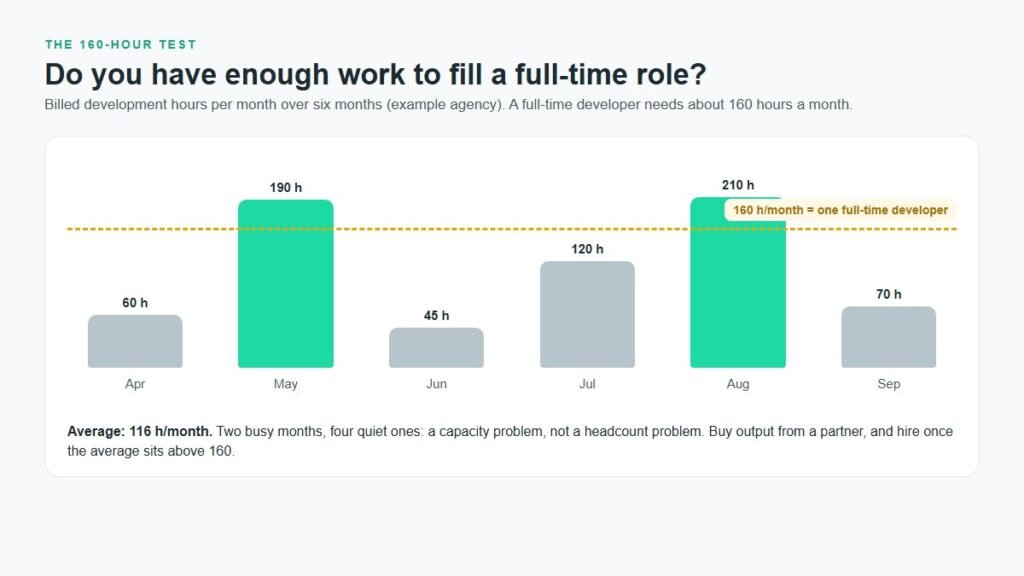
Run the honest count. Add up the development hours you actually billed over the last six months, not the hours you wished you had. If the monthly average sits comfortably above 160, hiring is a real option. If it swings between 40 and 200 depending on what closed, you are buying availability you cannot use.
What an in-house developer actually costs
More than the salary, and the gap is bigger than most agency owners budget for. ZipRecruiter puts the US average for a WordPress developer at $84,542 a year, with most salaries between $60,500 and $99,500 (as of August 2026). Senior developers average $128,400. Then add everything that is not salary:
Together those add roughly 30% to 40% on top of base pay, and a common planning shortcut is salary multiplied by 1.75 to 1.85 for the real annual cost. So the number to plan against is not $85,000. It is comfortably over $100,000, before anyone writes a line of code, and it is paid whether projects arrive or not.
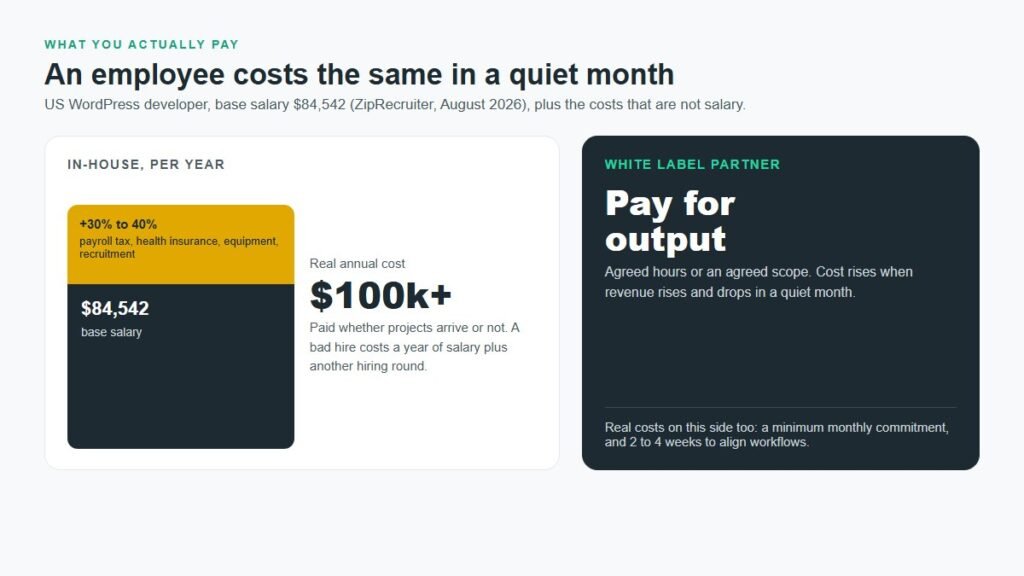
A bad hire is the expensive outcome, not an expensive hire: a year of salary, the recruitment fee, lost delivery time, and a second search. That risk is asymmetric in a way the salary comparison hides. A partner that underperforms costs you one project and a switch. With a partner you pay for agreed hours or an agreed scope, and our breakdown of the true cost of white label WordPress development covers what those rates include. Two honest costs on the partner side: good partners usually want a minimum monthly commitment, and expect two to four weeks of aligning communication and workflow before the first client project ships smoothly.
When hiring in-house is the right call
Hire when the work is steady, strategic and yours to own. Five situations where an employee genuinely beats a partner:
You clear the utilisation test. Multiple active sites, weekly changes, or continuous custom development that reliably fills a role.
Development is your differentiator. If clients buy you because of what you build rather than what you deliver, that capability belongs inside the business.
You need someone in the room. Architecture decisions, discovery calls, and thinking alongside your strategists. A partner executes well and does not sit in your Monday meeting.
Contracts require it. Some clients, particularly in regulated sectors, prohibit external contractors touching their code. That decides it regardless of cost.
You are building for years, not quarters. An employee accumulates knowledge of your clients, your standards and your stack. That compounds, and it is the one thing outsourcing cannot replicate.
If three or more of those describe your agency, hire. The rest of this guide will not change that, and it should not.
When a partner makes more sense
When work arrives in waves, or when one person cannot cover the ground you need covered. The wave problem is the obvious one: a salary does not flex with your pipeline, and a partner absorbs the peaks without leaving you paying for the troughs. The capability argument is the stronger one and it gets overlooked. WordPress delivery spans security, performance, backups, custom development and increasingly AI visibility. A single hire is rarely strong across all of them, which is the same reason repair costs vary so much between tiers.
There is also a capacity ceiling. Managing a pool of individual contractors tends to break down around six to eight concurrent projects, when coordination starts consuming your internal team. A single partner with its own project management does not hit that wall in the same way. Speed matters too: hiring takes months, a partner takes weeks, and when a project you want lands outside your team's skill set, that difference decides whether you bid at all.
The structure most agencies land on
Neither pure option wins for most agencies. The pattern that works is hybrid: keep strategy, client relationships and quality control inside, delegate execution outside. In practice that means one internal person who owns standards and client communication, plus a partner absorbing build volume. The internal hire stays busy because their role is not just development. The partner scales up and down with the pipeline.
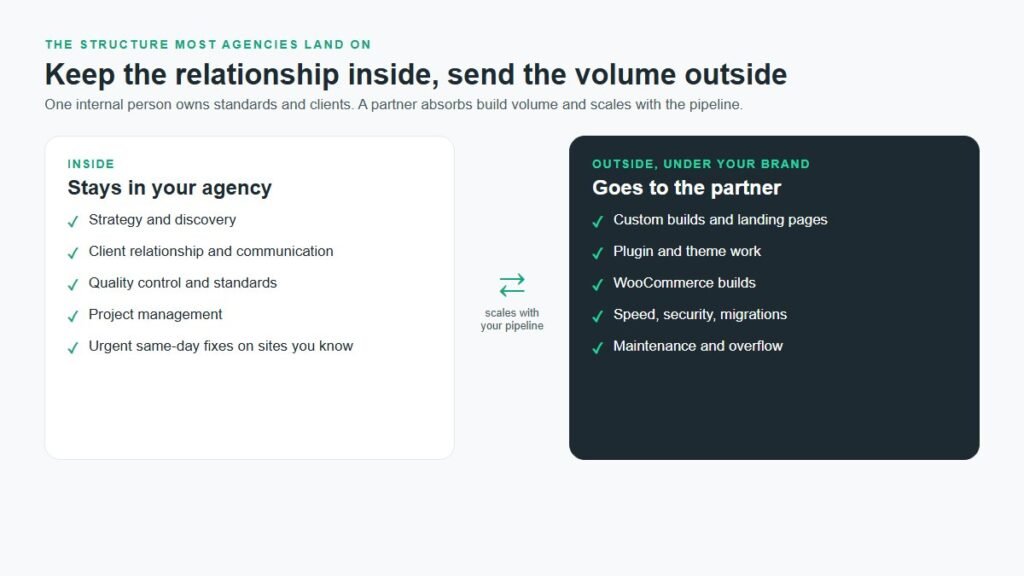
If you are earlier than that, start with a partner and hire once utilisation is proven rather than predicted. Hiring against a forecast is how agencies end up with an expensive person updating plugins.
Which outsourcing model is right for your agency?
The right model depends on project size, how often you need help, and how much management you can absorb. Three very different setups all get called "outsourcing," and they carry different costs, accountability, and risk.
A freelancer is a good fit for a small, clear task where flexibility matters. An offshore team suits larger or ongoing work when you have process to manage it. A white label partner is built specifically for agencies that want the work delivered under their own brand, with the client relationship protected. It is also how Survyc works: agencies outsource WordPress development to our white label team and keep every client conversation. Our comparison of a freelancer versus a white label partner goes deeper on the first and third.
When does offshore WordPress development actually work?
Offshore works when you have process, and struggles when you do not. The rate difference is real, and so is the coordination cost that eats into it. Three things decide the outcome: timezone overlap of three or four hours, so a blocked question does not cost a full day; written specification, since ambiguity a local developer resolves over a quick call becomes a wrong build overnight; and a named contact rather than a rotating pool, because context does not transfer between people for free.
Get those right and offshore delivery is strong value at scale. Get them wrong and you pay the rate difference back in management hours. That is the same trap the cost section below describes.
How much does it cost to outsource WordPress development?
Costs vary widely by model and region, so judge the total cost, not the hourly rate. As of 2026, US-based WordPress developers and agencies typically charge $100 to $200 per hour. Offshore teams in regions like South Asia, Southeast Asia, Eastern Europe, and Latin America generally run $20 to $60 per hour. On a 100-hour project, that gap looks like thousands of dollars on paper.
The paper gap is not the real number. A lower hourly rate means less if you spend five hours a week managing the project, fixing miscommunication, and covering quality gaps. The Small Business Administration's guidance on managing your finances makes the same general point: the direct fee is rarely the total. The honest comparison is your total cost after management time and rework, against the total value delivered.
Post-launch costs also run roughly 15% to 25% of the original build cost each year for maintenance, so budget for the life of the site, not just the launch. For agencies specifically, the white label model often prices per project or as a percentage of what you charge the client, which keeps your costs tied to revenue instead of hours you have to babysit. Our breakdown of white label WordPress pricing covers the partner rates by project type and the margin you should keep.
How do you vet a WordPress outsourcing partner?
Vet for three things: relevant technical skill, communication, and process, and test all three with a small paid task before you commit. Poor communication, not weak coding, is the number one cause of failed outsourcing relationships, so this step matters more than any portfolio.
Start with a real vetting sequence. Check portfolio examples of the exact task you need, then ask for a live URL and run it through a speed test yourself. Send a detailed brief and watch how they respond. Strong partners ask clarifying questions and flag issues you had not considered. Weak ones just say yes to everything.
Then run a paid test task, something in the $500 to $1,000 range. This single step protects you more than any sales call. A small real job shows you their actual code quality, their speed, and their communication, before you hand over a $20,000 project. Our full vetting checklist for a development partner covers the questions to ask and the answers that should make you pause.
What are the biggest risks, and how do you avoid them?
The biggest risks are miscommunication, poor code quality, security gaps, and losing control of the client relationship. Each one is avoidable with the right setup.
Miscommunication
Agree on how updates are shared, how often you get reports, and how issues are escalated, before work starts. Set overlapping working hours with offshore teams.
Poor code quality
Insist on clean, documented, standards-compliant code. Nulled or pirated plugins are a hard no; they introduce malware across your whole client portfolio.
Security gaps
Confirm the partner uses staging environments, daily backups, and role-based access. Skipping staging before pushing updates causes most WordPress update failures.
Losing the client
Use an NDA and a no-contact policy so the partner never approaches your clients. A real white label partner protects your position by design.
Name the risk, set the rule that removes it, and you have handled the part of outsourcing that burns most agencies.
How do you keep control of the client relationship?
You keep control by staying the only face the client sees, and by choosing a partner built to stay invisible. This is the fear that stops most agencies from outsourcing at all: "Will they go around me and take my client?"
The protection has two layers. The legal layer is an NDA and non-solicitation clause signed before any work begins. The practical layer matters even more: route all client communication through your agency, keep deliverables and staging unbranded, and hold credentials in your own accounts. When the client only ever experiences your agency, there is nothing to poach.
Some agencies go further and bring the partner onto client calls as part of the team. That trades a structural protection for technical depth in front of the client. It is a legitimate choice, and it makes the non-solicitation clause carry more weight. Whichever you choose, agree handover terms and code ownership before the first project, not during a crisis; repositories and credentials should sit in your accounts.
How do you start outsourcing without risking a live client site?
Start small, on a low-stakes project, and scale only after the partner proves themselves. Never hand a brand-new partner your biggest client's live site on day one.
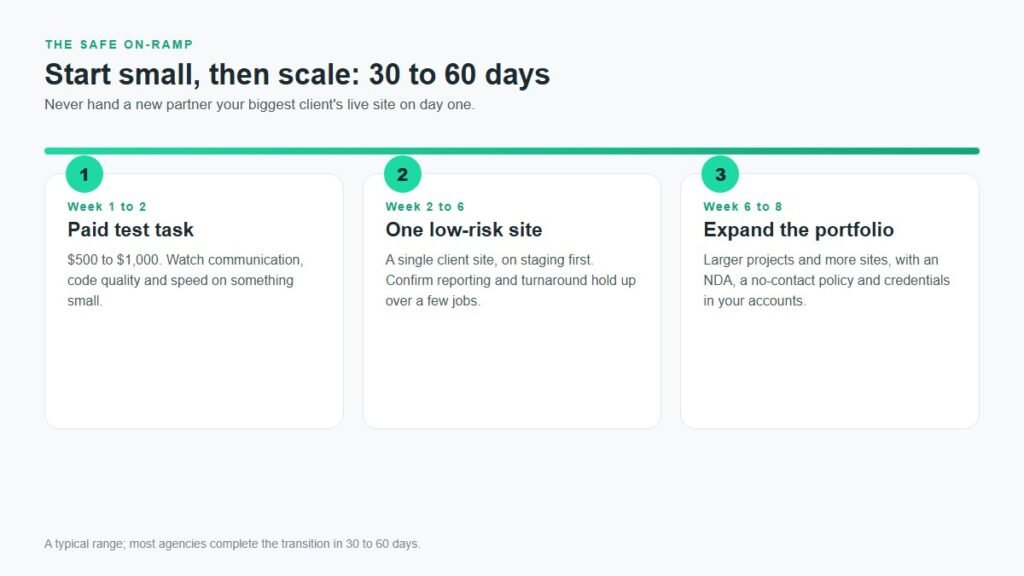
Begin with one small paid task. Use it to learn how the partner communicates and delivers.
Move to a single lower-risk client site. Confirm they work in a staging environment, not directly on the live site, and that reporting and turnaround hold up over a few jobs.
Once quality and communication hold, expand to larger projects and more of your portfolio.
Most agencies complete this transition over 30 to 60 days. Building trust in stages is how you get the upside of outsourcing without gambling a client relationship you worked hard to earn.
Key takeaways
WordPress development outsourcing works as a process, not a quick handoff. Define the exact scope, keep the client relationship and project management in-house, and pick the model that fits your work: freelancer for small tasks, offshore team for scaled builds, white label partner for branded agency delivery.
Decide whether to outsource at all with the 160-hour test, not a rate table. An employee costs well over $100,000 a year and the same in a quiet month; a partner costs more per hour and less per year, because you pay for output. Most growing agencies end up with one person inside and execution outside.
Judge cost by the total after management and rework, not the hourly rate. Vet with a small paid test, because communication fails more projects than code does. Protect yourself with an NDA, non-solicitation, staging environments, and a partner who stays invisible. Start small, then scale once trust is proven.
Frequently asked questions
What does it mean to outsource WordPress development?
It means hiring an external developer or team to build, fix, or maintain WordPress sites for your agency instead of doing it in-house. You keep the client relationship, sales, and strategy, while the outsourced team handles technical execution, often under your brand.
How much does it cost to outsource WordPress development?
As of 2026, US developers and agencies typically charge $100 to $200 per hour, while offshore teams run $20 to $60 per hour. For agencies, white label partners often price per project or as a percentage split. Judge total cost after management time, not the hourly rate alone.
Can you outsource custom WordPress development safely?
Yes, provided you agree ownership and documentation before work starts. Confirm who owns the code and repository, insist on documentation, and require standards-compliant work rather than core file edits. Undocumented custom development becomes the most expensive part of a site to maintain.
Should I outsource WordPress plugin development?
For contained modifications, usually yes. For a plugin built from scratch, agree the maintenance arrangement first, since custom plugins need updating as WordPress core and PHP versions change. An unmaintained custom plugin eventually breaks the site it was built for.
Can I outsource WordPress design as well as development?
Yes, though they are separate skills and few partners are equally strong at both. Most agencies keep design closer to the client relationship and outsource the build. Agree the deliverable format in writing either way. A Figma file with defined components is buildable; a flat image is not.
Is it better to hire a freelancer or an agency to outsource WordPress?
Freelancers suit small, well-defined tasks where flexibility matters. Agencies and white label partners suit larger projects, tight deadlines, and ongoing work where you need reliability, QA, and backup. For agencies delivering to clients, a white label partner keeps you client-facing.
How do I make sure the code quality is good?
Ask for portfolio examples of the exact task, check a live URL yourself, and run a small paid test task of $500 to $1,000 before committing. Insist on clean, documented code, staging environments, and no nulled plugins.
Will an outsourced partner steal my clients?
A proper white label partner will not. A signed NDA and non-solicitation clause prevent it legally, and a real partner works invisibly under your brand, so there is no opportunity or incentive to go around you. Their business depends on agencies trusting them.
What WordPress tasks should I not outsource?
Keep direct client project management, bespoke client training, and urgent same-day fixes closer to home, since these shape the client experience most. A good partner supports all of these behind the scenes while your agency stays the client-facing brand.
Ready to outsource WordPress development the right way?
If you want a partner that works as your invisible team, protects your client relationships, and delivers clean work on time, that is exactly what we do. Survyc is an AI-first digital agency, and we cover custom builds, plugin work, and ongoing maintenance under your brand, on a per-project or dedicated-developer basis, with a signed NDA and no long-term contract.
Still weighing a hire against a partner? Send us your monthly development hours and we will walk through the numbers with you. If the honest answer is that you should hire, we will say so. Learn more about our white label WordPress development for agencies, or send us a small test project to see how we work. Email info@survyc.com.
Send a test projectLast reviewed: September 2026. Rates and salary figures are dated in the text and change often, so this guide is reviewed every quarter.
