

AI visibility is how often and how accurately AI platforms such as ChatGPT, Perplexity, Gemini and Google AI Overviews name and cite your brand when people ask about your category. Search rankings put pages in a list. AI visibility is closer to binary: the answer either names your brand or it does not.
The same moment keeps coming up in the audits I run. A business ranks well on Google and feels safe. Then it asks ChatGPT the exact question its customers ask, and finds a competitor named in the answer instead. Nothing in its analytics warned it.
That gap is what this guide is about. It covers both halves: what it is and how to measure it, then the working part, how to improve brand visibility in AI search engines once you know where you stand.
What this guide coversWhat is AI visibility?
It is how frequently and how favourably a brand appears in AI-generated answers across ChatGPT, Google AI Overviews and AI Mode, Gemini, Perplexity, Claude and Microsoft Copilot. It covers three things: does the AI mention your brand, does it cite your website as a source, and how does it describe you when it does.
The citation model is what changes everything. Traditional search gives every brand a position on a list. An AI engine reads many sources, writes one answer, and names a handful of brands inside it. There is no position seven in a ChatGPT response. You are either in the answer or you are not.
Some teams split the idea into narrower terms. AI search visibility means presence across AI-powered search surfaces. LLM visibility means how well the underlying models know your brand, which is closely tied to entity SEO. AI brand visibility adds sentiment: not just presence, but how you are portrayed. All three point at one question. When a buyer asks an AI about your category, does your name come up?
How is AI visibility different from traditional SEO?
SEO gets your pages ranked in a list of links. The other gets your brand selected inside a single written answer. The two are related, but one does not guarantee the other, and this is the part that surprises most business owners.
AI engines retrieve from across the web using their own weighting, not just the top of the results. Google's own documentation on AI features says AI Overviews and AI Mode may use a "query fan-out", running several related searches across subtopics before writing a response. A 2026 survey of generative engine optimization research reports one audit finding that 53% of domains cited in Google AI Overviews did not appear in the organic top 10.
The reverse also happens. A smaller brand with clearer, more quotable pages gets named over a bigger competitor that outranks it, because a competitor that answers five sub-questions on clear pages gives the engine five pages to pull from.
Why does AI visibility matter now?
Because a growing share of buying research ends inside the AI answer, and the clicks that used to follow a search are thinning out. Pew Research Center found that Google users who saw an AI summary clicked a traditional result in 8% of visits, against 15% for users who did not see one. Gartner predicted a 25% drop in traditional search engine volume by 2026 as chatbots and AI agents absorb queries.
Put that together with how few brands an answer names, and the conclusion is hard to avoid. Fewer clicks exist, and only a handful of brands per question are in the running for them. A business that is not showing up in AI answers is not losing a ranking position. It is missing the conversation.
How do AI engines decide which brands to cite?
AI engines cite brands whose information they can find, understand, trust, and extract. Each of those four words is a real requirement, and most visibility failures I diagnose trace back to one of them.
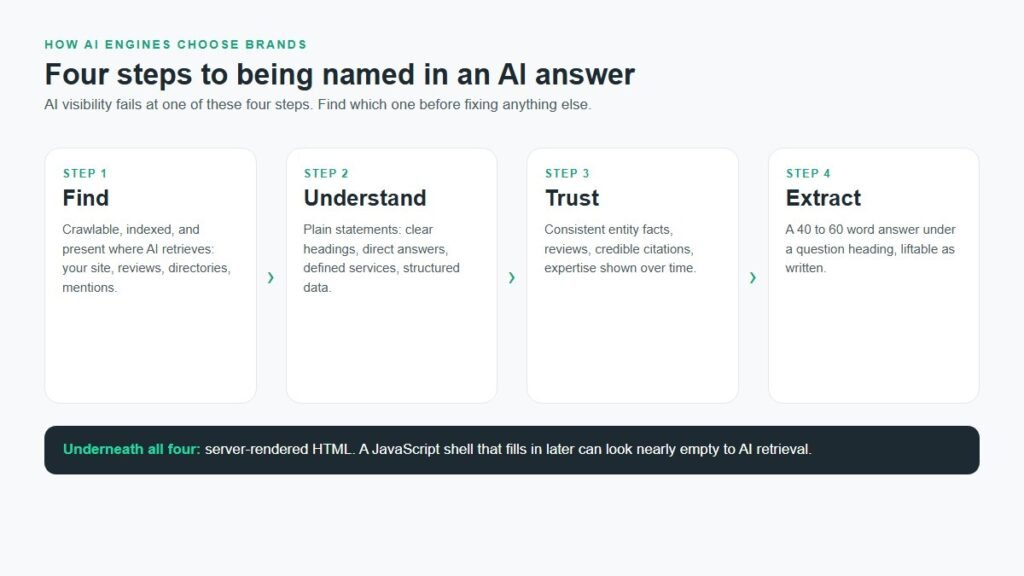
Find. Your content is crawlable and present where AI systems retrieve from: your site, review platforms, directories and third-party mentions. A page Google has not indexed cannot be a source, so fixing page indexing issues comes first.
Understand. Pages state things plainly: clear headings, direct answers, defined services, structured data.
Trust. Consistent entity information, reviews, credible citations, and expertise shown over time.
Extract. The answer exists in a liftable form: a 40 to 60 word answer under a question heading, not the same point buried in four paragraphs.
There is a technical layer under all four. Pages rendered on the server deliver complete HTML on the first request. Pages built as JavaScript apps deliver an empty shell that fills in later, and AI retrieval handles that worse than search engines do. My guide to turning AI-generated designs into a working WordPress site covers that difference, and Core Web Vitals matter for the same reason.
How do you measure AI visibility?
Run the questions your customers actually ask, several times each, and record whether, where and how your brand appears. The core metrics are mention rate, citation share of voice against competitors, which of your URLs get cited, and whether the description of you is accurate.
What is an AI visibility score?
It is one number summarising your presence across AI platforms, usually blending mention rate, citation share and sentiment over a fixed set of prompts. Every tool calculates it differently, and there is no shared standard. So the absolute number means little and the trend means a lot: the same score moving up over a quarter, same tool and same prompts, tells you the work is landing.
Three rules keep it honest. Stay with one tool, because switching resets your baseline. Fix your prompt set, because changing the questions changes the score. And track competitors alongside yourself, since your score can fall while your relative position improves. My comparison of tracking tools covers what each one actually measures.
How to check your brand's AI visibility in ten minutes
Write ten questions a customer asks before hiring a business like yours, in their words, not your keywords.
Run each one in ChatGPT, Perplexity, Gemini and Google AI Overviews, in a logged-out or private window.
Run each question three times, not once. AI answers vary between runs, so one check tells you almost nothing.
Record whether you were named, which brands were named instead, and which URLs the answer cited.
Repeat monthly with the same questions and compare the percentage of runs where you appeared.
That percentage is your real baseline, and it appears in no analytics dashboard. Keep it in a sheet with one row per question, per platform, per run:
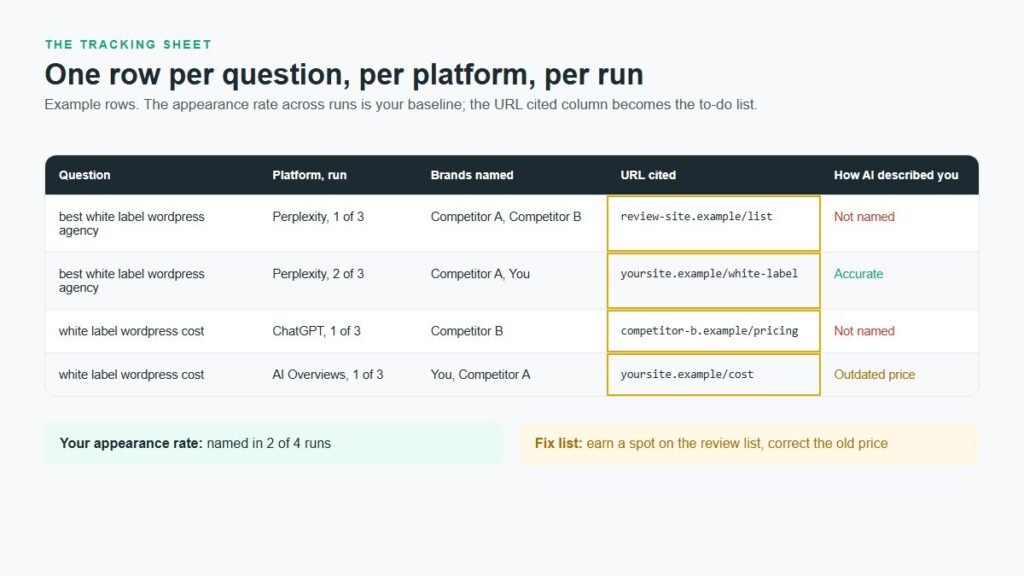
Two things usually surprise people the first time. The competitor named most often is rarely the one ranking highest on Google. And the cited sources are often directories, review sites and forums rather than anyone's own website.
How do you improve brand visibility in AI search engines?
Publish answers AI can quote without editing, back them with data only your business holds, keep your brand facts identical everywhere, and earn mentions on the sites AI already cites for your buyers' questions. Then rerun the same questions against named competitors every month to see what moved.
Start with the questions a competitor owns
Take your tracking sheet and find the questions where a competitor appears in most runs and you appear in none. That is a competitive analysis, and it is the best starting point because it tells you exactly what to fix. My step-by-step guide to running an AI brand visibility competitive analysis covers prompt design, run counts, and how to read the results without fooling yourself.
Then open every URL the AI cited for that competitor. Each one falls into one of two buckets, and the bucket decides the fix.
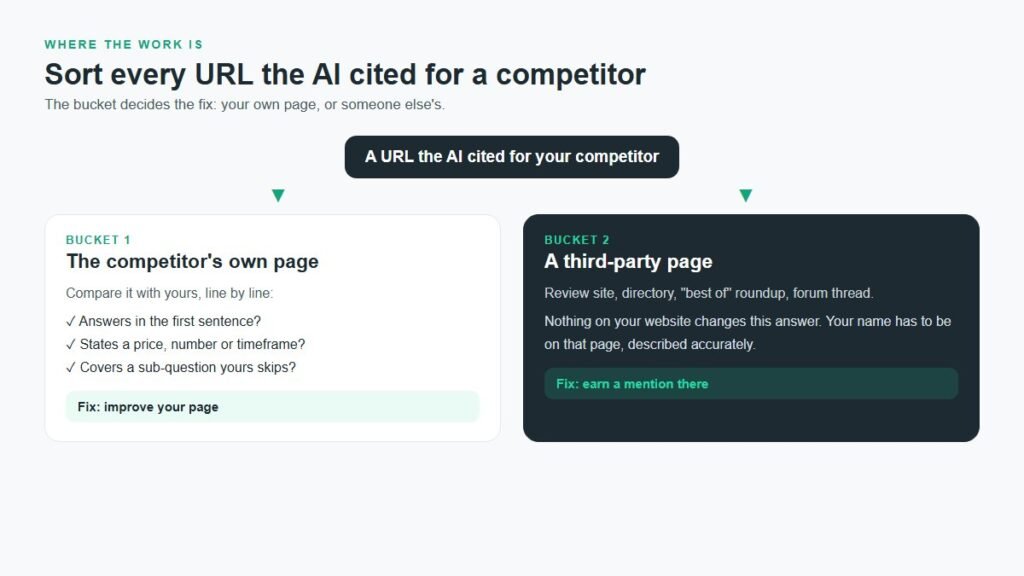
If the cited URL is the competitor's own page, compare it with yours line by line. Does it answer in the first sentence? Does it state a price, number or timeframe yours leaves out? Does it cover a sub-question yours skips? If the URL belongs to a review site, directory, roundup or forum thread, the fix is not on your website at all. You need your name on that page, described accurately.
Make every page quotable
AI engines judge passages rather than whole pages. Give each question its own heading and answer it completely in the first 40 to 60 words beneath it, without leaning on anything above. An answer spread across four paragraphs of setup loses to a competitor that answered in one sentence.
Write the conclusion into the sentence instead of leaving it to be inferred, and put comparisons in tables. Rebuild the page you already have rather than publishing a new one, since the existing URL keeps the standing it has earned. If a restructure forces a URL change, follow a redirect process that keeps existing traffic.
Use data only your business holds
Statistics and citations still help, but the famous figure needs context. The Princeton-led GEO study (Aggarwal et al., KDD 2024) found citing sources, adding quotations and adding statistics raised visibility by 30% to 40% on its main metric. That was in a test setup with five documents already loaded, not live ChatGPT answers. A 2025 follow-up, C-SEO Bench, found most published methods of this kind largely ineffective once several competing sites used them at once.
Read together, the two point to one rule. A borrowed statistic credits its original source, and every competitor can paste the same line. The durable version is a number only you can publish: jobs completed, average turnaround, prices you actually charged with the date, the causes you keep finding on site. It needs no research budget, only someone to write the numbers down.
Keep your brand facts identical everywhere
AI engines assemble one answer from many sources, and contradictions lower their confidence in naming you. A founding year that differs between LinkedIn and your About page, or a service no directory lists, gives the engine two versions of your business and a cleaner option in your competitor.
Write one description of about 150 words: who you are, what you do, who you serve, where you work, and why a buyer should trust you. Reuse it on your site, Google Business Profile, LinkedIn and every directory, trimmed where needed but never contradicted. Make your About page the entity home, link it to every profile and back, and add Organization schema whose sameAs list points at those profiles.
Earn mentions on the pages AI already cites
Your tracking sheet already lists them: every review site, directory, roundup and thread in the "URL cited" column. Reviews change fastest. Ask customers to name the service they bought and what went well, because a five-star rating with no text gives an engine nothing to match against the next buyer's question.
Roundups and industry sites take longer. Editors ignore link requests from strangers, so arrive with something useful: an interview, a data point they can cite, or a correction to an outdated listing. Skip bought reviews, which break the rules of the major platforms.
Does schema markup help?
Schema helps machines read a page, but it is not a shortcut to citations. Google says AI Overviews and AI Mode need no special optimisations beyond standard SEO. Add markup that describes the page accurately, such as Organization with sameAs, Article, and FAQPage text that matches the visible answers, and keep it current, because a changed price or phone number in one place quietly contradicts you.
What does not work
Keyword stuffing
It did not help in the Princeton tests, and C-SEO Bench found most document-level manipulation ineffective or harmful.
Separate "AI versions" of pages
They duplicate your own content and split the signals each page earns.
Thin pages for every keyword variation
On a newer site they sit unindexed unless something links to them.
Bought mentions
One listing with no relationship behind it to earn the next one.
How long does it take to improve AI visibility?
It takes months rather than weeks, and any fixed number of weeks is a guess. Engines that search the web live, such as Perplexity, can reflect a rebuilt page once they recrawl it. Answers drawn from a model's training data change only when the model itself updates.
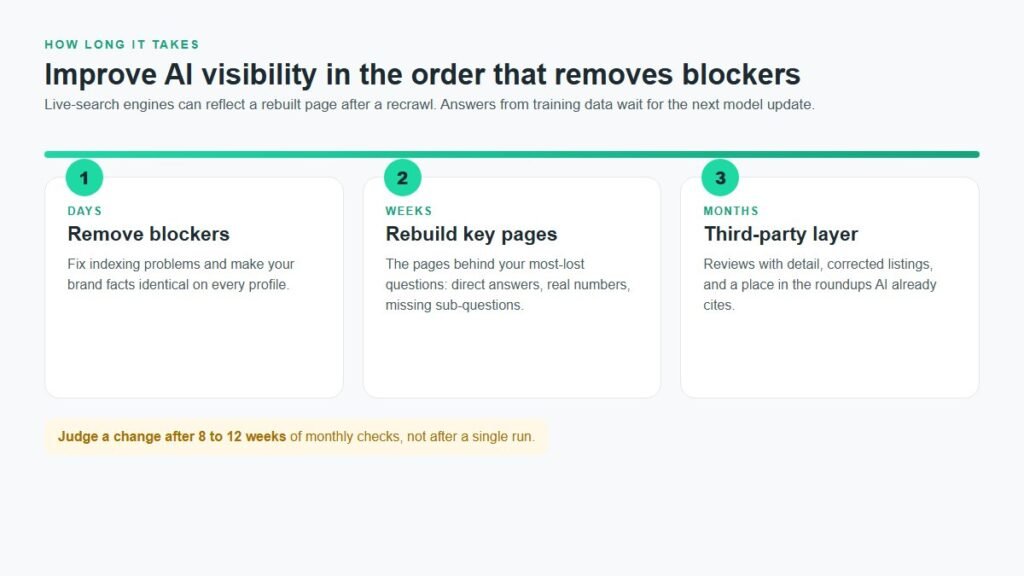
Work in the order that removes blockers first: fix indexing and inconsistent brand facts (days), rebuild the pages that match your most-lost questions (weeks), then work the third-party layer (months). Run the tracking sheet monthly and judge a change after 8 to 12 weeks.
Can small businesses compete on AI visibility?
Yes, and in some ways the field is more open than traditional SEO ever was. Because of query fan-out, a small business with clear pages on local pricing, comparisons and specific services gives the engine more pages to pull from than a big brand with one strong homepage. Data only that business holds gives the engine a reason to cite it.
The window matters. Most businesses still measure only rankings. The next phase is AI agents that research, compare and act for the user without visiting a website, and when an agent does the shopping, clear and machine-readable service information stops being an optimisation and becomes the storefront.
Key takeaways
AI visibility is how often AI platforms name and cite your brand when buyers ask about your category. It differs from SEO because an answer names only a handful of brands, ranking first guarantees nothing, and clicks are thinning where AI summaries appear.
Measure it by running your customers' real questions monthly, three runs each, and tracking the percentage where you appear. Treat any score as a trend line, because no two tools calculate it the same way.
To improve, start from the questions a competitor owns and the URLs cited for them. Make pages quotable, publish numbers only you hold, keep brand facts identical everywhere, and earn mentions on the pages AI already cites. Judge progress over months, not single runs.
Frequently asked questions
What is AI visibility in simple terms?
AI visibility is how often AI platforms like ChatGPT, Perplexity, and Google AI Overviews mention or cite your brand when answering user questions. If a customer asks an AI for recommendations in your category and your name appears, you have AI visibility. If it does not, you are invisible to that buyer.
How is AI visibility different from SEO?
SEO ranks your pages in a list of search results. AI visibility decides if your brand gets named inside a single AI-generated answer. Ranking first on Google does not guarantee AI platforms will cite you, because AI engines retrieve and weight sources using their own logic.
How do I check my brand's AI visibility?
Write down the questions your customers ask before buying. Run them across ChatGPT, Perplexity, Gemini and Google AI Overviews, three times each in a private window. Record if your brand is mentioned, which sources are cited, and how you are described. Repeat monthly with the same prompts.
How do I improve my brand's visibility in AI search engines?
Put a direct 40 to 60 word answer under every question heading, add data only your business can publish, keep your brand facts identical on every profile, and earn mentions on the review sites and directories AI already cites. Then run your buyers' questions monthly across ChatGPT, Perplexity, and Google AI Overviews to see what moved.
How do I check if AI mentions my competitors more than me?
List 10 to 15 questions your buyers ask, run each one three to five times on ChatGPT, Perplexity, and Google AI Overviews, and record every brand named and every URL cited. Count how often each competitor appears across all runs. That appearance rate, compared month to month, shows who owns each question.
Does AI visibility replace SEO?
No. SEO fundamentals still get your content indexed and competitive, and strong organic authority feeds AI visibility. The change is that SEO alone is no longer enough. AEO and GEO extend the same foundation so your brand is also selected when AI generates the answer.
Does schema markup make AI cite my site?
Not on its own. Schema helps machines read a page, but Google says AI Overviews and AI Mode need no special optimizations beyond standard SEO. Add Organization, Article, and FAQPage markup that matches your visible text, and keep it current, because outdated schema quietly contradicts what your page says.
How long does it take to improve AI visibility?
Expect months rather than weeks. Model training cycles, retrieval indexes and third-party mentions all update on their own schedules. A change you publish today may take several weeks to reach answers. Track monthly and judge the trend over a quarter rather than reacting to one check.
Want to know which questions your competitors own?
Survyc runs audits that start with exactly this check: your buyers' real questions, run several times across ChatGPT, Perplexity and Google AI Overviews, with every cited URL sorted into a fix on your site or a mention to earn. We then do the AEO and GEO work that closes those gaps, and for SEO agencies we implement it white label through our AI visibility implementation service.
Send us the three competitors you lose to most often and we will start with the questions they own. Ask for a visibility check, or email info@survyc.com.
Ask for a visibility checkLast reviewed: September 2026. AI platforms and the studies cited here change often, so this guide is reviewed every quarter.
