
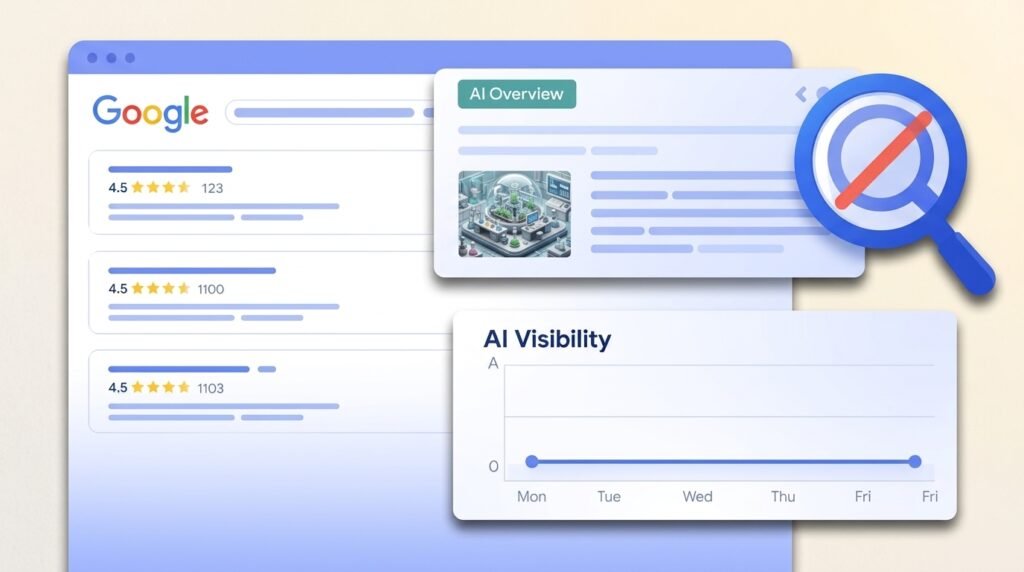
An AI engine has to do four things before it names you: find your content, work out what you are, decide you can be trusted, and choose you over the alternatives. A business not showing up in AI answers has failed at one of those stages, and each one has its own test and its own fix. Ranking well on Google does not carry you through any of them.
That last part is the one that catches people. You did the SEO properly, it worked, and it turns out to have been necessary without being sufficient. This article is about finding which stage is the gap.
First: are you sure you are not showing up?
Before diagnosing anything, confirm the problem is real, because a single empty result proves nothing.
AI answers are probabilistic. Ask the same question twice and you get different brands. The 2026 AirOps research put a number on it: only around 30% of brands stay visible from one answer to the next, and about 20% across five runs. Answers also change with location, with the phrasing, and with what the tool remembers about you.
So run each question three to five times, in a private window, across ChatGPT, Perplexity, Gemini, Claude and Google AI Overviews. Record how many times out of five you appear. Our guide to what AI visibility is sets out the full method. Zero out of five is a diagnosis. One out of five is Tuesday.
Ranking on Google is not the same test
This is the mechanism behind the frustration, and it is worth understanding before touching anything.
Google ranks a list of pages by authority and relevance. AI engines work differently. They retrieve chunks of content from across the web, then select the ones most directly quotable for the question asked. The retrieval step is called Retrieval-Augmented Generation, and it reads the open web rather than Google’s rankings.
The consequence shows up in the data. AirOps found that roughly 60% of Google AI Overview citations come from URLs outside the top 20 organic results. The same AirOps research found pages ranking number one on Google get cited by ChatGPT only around 43% of the time. Two different contests, scored two different ways. A page can win the first and lose the second without anything being wrong with it.
Your SEO did its job. It built the foundation the next four stages sit on.
Stage 1: can AI find you at all?
Retrieval reads public HTML. A page that Google has not indexed, or one that arrives as an empty shell and fills in with JavaScript afterwards, gives the engine nothing to retrieve. It cannot cite what it cannot read.
The test. Search site:yourdomain.com and check the count against how many pages you actually have. Then open your main service page, right-click, View Page Source, and confirm the real content is in there rather than loaded later by a script.
If this stage failed. Indexing problems have their own fix in our guide to page indexing issues. Rendering problems are the JavaScript question, which our guide to AI-generated designs and WordPress explains. Sites built as React applications, on Webflow, or from AI builders hit this one most.
Stage 2: can AI tell what you are?
The engine found you. Now it has to classify you, and that depends on consistency. If your name, description, location and services differ between your website, your Google Business Profile, LinkedIn and every directory, the model cannot build a confident picture of what you are.
Google’s own AI Mode describes the goal as being “a trusted, relevant, and well-corroborated entity.” Corroboration is the key word. When independent sources agree about you, you become a verified fact. When they disagree, you become a rumour.
The test. Type your business name into ChatGPT and Perplexity and ask what the company does. Read the answer as a stranger would. Wrong industry, wrong city, a founder who left three years ago, or confusion with another company sharing your name: any of those means Stage 2 failed.
Showing up wrong is this stage failing differently. It is arguably worse than not showing up. With no reliable source to draw on, AI tools invent hours, prices and policies, and Search Engine Journal has reported at length on how often AI answers about business locations are simply wrong. If you appear with the wrong details, the fix is the same as for not appearing: one consistent description everywhere, starting with your own About page.
Stage 3: does AI trust you?
You are found and correctly understood, and the engine still wants evidence from somewhere other than your own site. Your website saying you are good is a claim. A review, a directory listing, a mention on someone else’s page, a Reddit thread: those are evidence.
The 2026 data makes the split clear. AirOps found around 85% of brand mentions in AI answers originate on third-party pages, and roughly 48% of citations come from community platforms like Reddit and YouTube. For local queries the balance flips: Yext found around 86% of citations come from owned sources, meaning your Google Business Profile and your own site. Which one matters more depends on the question your customers ask. “Who is the best plumber in Plano” leans on owned sources. “Which CRM should a small agency use” leans on the community.
The test. Ask an AI tool for reviews of your business by name. If it returns nothing, or returns only your own website, Stage 3 is the gap. Then ask it the question your customer would ask and look at which sources it cites for your competitors. That list is your citation map.
If this stage failed. Reviews that mention specific services, a complete Google Business Profile, directory listings that actually describe you, schema markup that states your business details in a form machines read directly, and genuine presence where your customers talk. Our guide to improving brand visibility in AI search covers the tactics.
Stage 4: does AI choose you?
Everything above passed and the engine still names a competitor. This is a quotability problem.
Engines do not cite pages. They extract fact-sized chunks and assemble an answer from several of them. AirOps found that only about 15% of pages retrieved for a query end up cited in the final answer. Retrieval is not selection. Your page holds the answer in a paragraph, a competitor’s holds it in a 40-to-60-word block under a heading phrased as the question, and the engine lifts the competitor’s.
There are two ways to be chosen, and the AI Mode text names them: as a mention, where the engine recommends you as an option, and as a citation, where it quotes your page as a source. Mentions come from Stage 3. Citations come from here.
The test. Ask the question, note who got cited, open their page. Compare the structure to yours. Is their answer at the top or buried? Is it under a question heading? Could you lift the first sixty words and have them make sense alone?
If this stage failed. Restructure. Answer first, question headings, one specific claim only you can make. That is the work our AEO and GEO service does, and it is work rather than a setting.
There is no form to fill in
Worth saying plainly, because “how do you add your business to AI?” is one of the most common questions around this and the honest answer surprises people.
There is no submission. No “add to ChatGPT” the way there is “add to Google Business Profile.” The model learns what it learns from the public web, and you influence it by shaping what the public web says. Every one of the four stages above is a form of that. None of them is a form.
One monitoring tool worth knowing about: Bing Webmaster Tools has an AI performance dashboard showing which of your URLs get cited in generative answers. It matters more than it sounds, because ChatGPT and several other assistants lean on the Bing index rather than Google’s.
Key takeaways
A business not showing up in AI answers has failed at one of four stages: being found, being understood, being trusted, or being chosen. Test each one in order, because the fix is different at each.
Before any of that, confirm the problem is real by running each question five times. Visibility is volatile, and one empty result is noise.
And stop treating Google rankings as the measure. Roughly 60% of AI Overview citations come from outside the top 20 organic results. The two systems score different things, your SEO built the foundation, and the four stages are what sits on top of it.
Frequently asked questions
How do I get my business to show up in AI results?
Work through four stages in order. Confirm your content is indexed and readable without JavaScript. Make your name, description and services consistent across your site, Google Business Profile and directories. Build third-party evidence through reviews and mentions. Then structure your pages so the answer sits at the top under a question heading.
How do I get ChatGPT to recommend my business?
Recommendations come from trust signals rather than from your own site. ChatGPT draws on reviews, directories, community discussion and consistent business information across the web. Ask it for reviews of your business by name. If it finds nothing, that is the gap to close first.
How do you add your business to AI?
You cannot. No submission process exists for ChatGPT, Perplexity or Google AI Overviews. AI tools learn from the public web, so you influence them by making your business findable, consistently described, corroborated by third parties, and quotable. There is no form.
Is ChatGPT always accurate about businesses?
No. With no reliable source to draw on, AI tools fill gaps with invented hours, prices and policies. If ChatGPT describes your business wrongly, the cause is usually inconsistent information across your site and profiles. One consistent description everywhere, starting with your About page, is the fix.
Can I do this myself?
The tests, yes. Anyone can run their customer’s question five times and check the four stages in an afternoon. The fixes vary. Consistency work and reviews are within reach for most owners. Restructuring pages for quotability and building third-party presence usually take more time than most businesses have.
Ran the tests and found the gap?
Knowing which stage failed is most of the diagnosis. Fixing it is a different amount of work depending on which one, and the honest answer is that Stages 3 and 4 take longer than most owners expect. Survyc is an AI-first digital agency, and we run AI visibility audits that tell you plainly where the gap is and what closing it involves, then do the AEO and GEO work to close it. Tell us the question your customers ask, and we will show you who gets cited instead of you and why. Reach out to Survyc or email info@survyc.com.
