

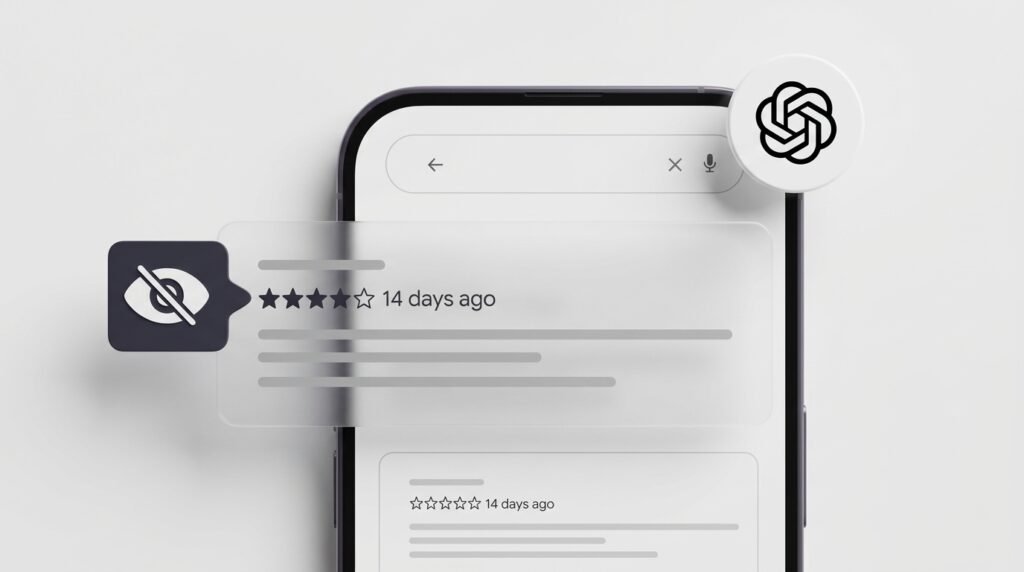
Your reviews are real, and they are in a place ChatGPT does not read. Most business reviews live on Google Business Profile, which ChatGPT does not crawl, or inside a JavaScript widget on your site, which AI retrieval cannot see. Nothing is wrong with the reviews. They need to exist as plain text somewhere an AI engine looks.
The businesses that ask me why ChatGPT does not show their reviews usually have hundreds or thousands of them and a rating they worked for. This is about relocation, not replacement.
Where your reviews actually are, and what AI can read
Start by working out where yours live, because the answer decides everything else.
| Where the reviews are | Can ChatGPT read them? |
| Google Business Profile | No. It is Google’s property and it is not in the Bing index ChatGPT searches |
| A review widget on your site (Trustindex, Elfsight and similar) | No. The widget renders after the page loads and retrieval reads the page before that |
| Facebook, or inside a booking app | Rarely. Login walls and dynamic loading |
| Yelp, Trustpilot, TripAdvisor, G2, industry directories | Usually yes, when the page is public and the text is in the HTML |
| Plain text on your own website | Yes. This is the one you fully control |
Two rows explain most cases. OpenAI runs ChatGPT’s live search on Bing’s index, and Bing does not index Google Business Profile or Google Maps content. So the place most businesses collect their reviews is a building ChatGPT never enters. And the most common way to fix that, embedding those Google reviews on your own site with a widget, uses the one method that does not work.
That second point deserves a plain sentence rather than a criticism. Adding a Trustindex widget was the right instinct. It puts reviews on your site, in a form only a browser can see.
Why the review widget on your site is invisible
Retrieval systems read the HTML a page sends on first request. A JavaScript widget sends a placeholder and fetches the reviews afterwards. The retrieval system sees the placeholder and moves on. The reviews are on the page for a person and absent for a machine.
This is the same reason sites built as JavaScript applications struggle with AI visibility generally, which our guide to AI-generated designs and WordPress explains in full. The fix here is narrower: the review text needs to be in the page source as ordinary text, not loaded in by a script.
The reviews that count are the ones that say something
Here is the part most owners miss, and it matters as much as where the reviews live.
A review reading “Great service, highly recommend!” tells an AI engine nothing it can use. No service, no problem, no location, no outcome. A review reading “They fixed our WooCommerce checkout in two hours after another agency gave up” is a citable fact about a specific capability.
When someone asks ChatGPT who fixes WooCommerce checkout problems, the second review is evidence and the first is noise. Volume matters less than specificity. Five reviews naming what you did beat fifty saying you were amazing.
So change how you ask. “Would you leave us a review?” gets you a five-star rating with no words in it. Ask the customer to say which service they used and what specifically made it good. That sentence is what an AI quotes back to the next person with the same problem.
Why negative reviews reach ChatGPT when positive ones do not
This looks like a contradiction and it is not.
If ChatGPT cannot see Google reviews, how do negative ones hurt? Because negative reviews travel. People screenshot them, quote them on Reddit, and mention them in forum threads and comparison posts, all of which ChatGPT reads. A glowing review stays on Google Business Profile where nobody but Google sees it. A furious one gets repeated across the open web.
Marcus Sheridan, who has written about this at length, describes the effect of negative Google reviews on ChatGPT recommendations as massive, and the mechanism above is why. The asymmetry is real. It argues for replying to every negative review properly and in public, because your reply is text on a page and it travels with the complaint.
Making your reviews visible to AI
Five things, in order of how much they move.
Publish review text on your own site as real HTML. A reviews page, or better, the review quoted on the service page it describes. As text in the page source, not a widget. A review about your WooCommerce work belongs on your WooCommerce page, where the AI finds it next to the service it wants.
Link each one back to its source. Google, Yelp, wherever it was posted. That verifies the review for machines and for people, and it avoids any appearance of inventing testimonials.
Collect reviews where AI reads. Yelp, Trustpilot and the directories specific to your industry are public and crawlable. To find which ones matter, ask a map-grounded AI directly: “What third-party sites do you reference when recommending [your industry] in [your city]?” That answer is your list.
Reply to every review, with detail. Replies are text on a public page. AI tools read them as another data source about what you do and how you handle customer service problems, and a reply that names the service and the outcome adds to the record.
Add schema, with a caveat. Review and rating markup helps machines parse your ratings. Google restricts self-serving review rich results, so marking up your own reviews on your own site will not produce stars in Google search. It can still help AI parsers read the numbers. Add it, and do not expect a visible change from it alone.
Our guide to improving brand visibility in AI search covers the broader tactics, and the four-stage diagnostic in why your business is not showing up in AI answers explains where reviews sit in the wider picture. They are the trust stage, which is the third of four.
A different problem: Google reviews not showing on Google
Worth separating, because a lot of people searching this question have a different problem.
If your Google reviews are missing from your Google Business Profile itself, that is Google’s moderation. Google filters reviews that trip spam detection, come from accounts with no history, arrive in a burst, or include links and prohibited content. Google publishes guidance on what it removes, and the fix runs through your Business Profile rather than your website.
That is a Google visibility problem. This article is about AI visibility. They overlap only in that both get better when reviews are specific and genuine.
Key takeaways
ChatGPT does not show your reviews because they live in places it does not read: Google Business Profile, which Bing does not index, and JavaScript widgets, which retrieval cannot see. The reviews are fine. The location is the problem.
Fix it by publishing review text as plain HTML on the matching service pages, linking each review to its source, and collecting reviews on the public platforms AI actually cites.
Then change what you ask for. A review that names the service and the outcome is evidence. A review that says “great!” is noise, and no amount of relocating it will make it useful.
Frequently asked questions
Can ChatGPT see my Google reviews?
No. ChatGPT’s live search runs on the Bing index, and Bing does not index Google Business Profile content. Your Google reviews are visible to Google and to people who visit your profile. ChatGPT cannot see them unless the same text also exists somewhere public and crawlable.
Does a review widget on my website help?
Not for AI. Widgets like Trustindex load reviews with JavaScript after the page renders, and AI retrieval reads the page before that. The reviews need to be in the page source as plain text. A widget is fine for visitors and does nothing for machine readability.
How do I get ChatGPT to recommend my business?
Give it evidence it can read. Publish specific reviews as text on your service pages, collect reviews on public platforms like Yelp and industry directories, respond to reviews in detail, and make sure your business is described consistently everywhere. ChatGPT recommends what the open web corroborates.
Do negative reviews affect ChatGPT?
Yes, more than positive ones. Negative reviews get quoted on Reddit, in forums and in comparison posts, all of which ChatGPT reads. Positive reviews tend to stay on Google Business Profile, which it does not. Reply to negative reviews publicly and with detail, because your reply travels with the complaint.
Why are my Google reviews not showing up on Google?
That is Google’s moderation rather than an AI issue. Google filters reviews that trip spam detection, come from new accounts, arrive in a cluster, or contain links. Google’s Business Profile help explains what it removes, and the fix goes through your profile, not your website.
Thousands of reviews and none of them reaching AI?
Moving reviews to where AI reads them is mostly structural work: the right text on the right pages, in a form machines can parse, linked to its source. Survyc is an AI-first digital agency, and we do that work as part of AI visibility audits for businesses and agencies, then say plainly what else is keeping you out of the answer. Send us your Google Business Profile link and your website, and we will show you what ChatGPT currently sees. Reach out to Survyc or email info@survyc.com.
